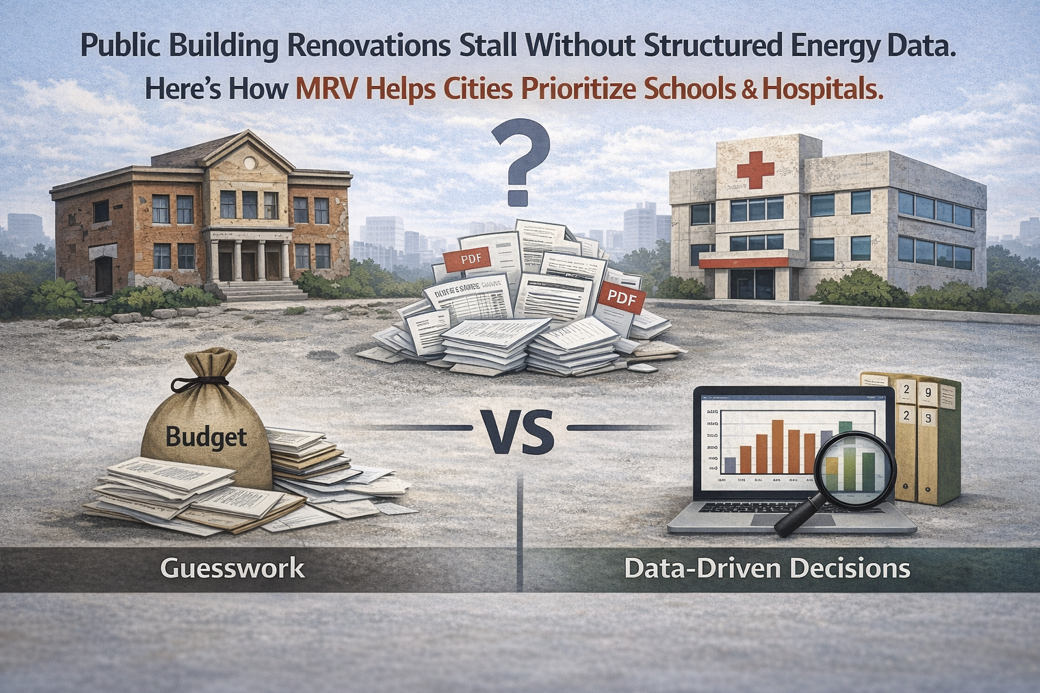
Public building renovations stall when cities lack structured energy data. Here’s how MRV (monitoring, reporting, verification) helps municipalities prioritize schools and hospitals, unlock budgets and deliver renovations that actually work.
In 2026, public-sector decarbonization is no longer a strategy deck topic. It is a budgeting problem, a procurement problem, and a delivery problem, especially in schools, hospitals, and municipal buildings.
The biggest blocker is surprisingly simple: lack of structured data. When consumption and building information live in notebooks, PDFs or disconnected files, cities can’t analyze portfolios, can’t prioritize correctly and often can’t justify funding at the speed required.
That’s why “cities run on data, not promises” has become more than a slogan, it’s an operational requirement.
Why budgets get stuck without structured data
When a municipality cannot answer basic questions, such as Which buildings are the biggest energy consumers? What is the baseline? Which interventions have the best payback?, budgeting becomes a guessing game.
The result is familiar: projects are selected for visibility, not impact; funds are spread too thin and renovations become partial quick fixes that look good at handover but don’t deliver long-term performance.
Răzvan Nica, CEO and founder of BuildGreen, makes the point clearly in this interview (Capital.ro, Dec 19, 2025), where he highlights data structure and monitoring as the practical starting point for cities. Read the article HERE
A concrete reality check
In Romania, we do see strong school renovation outcomes, but typically where there are clear energy performance criteria (targets, baselines, expected results), and supervision plus post-renovation verification, not just facade and windows.
When renovations are delivered to nZEB standards, cities get a clear definition of value-for-money in measurable targets, transparent verification and evidence that the intervention reduced energy costs.
The difference is accountability as the local authorities know what the money buys (measurable outcomes) and the building manager receives a renovation that performs in real life, not only on paper.
The MRV playbook: a correct process in 6 steps
A practical MRV process (Monitoring, Reporting, Verification) doesn’t need to be complicated,but it must be consistent and repeatable.
- Building inventory
Create a single list of assets (schools, hospitals, admin buildings), with minimum identifiers and attributes. - Baseline: where are we starting from?
Establish consumption and cost baselines by asset, using consistent time periods and data sources. - Top 20% consumers: where do we intervene first?
Rank buildings by energy use, cost and risk (e.g., hospitals will remain high-load by nature, so focus on control and efficiency). - Concrete measures
Define packages (envelope, systems, controls, operational fixes) tied to the baseline and expected outcomes. - Monitoring
Track actual performance after delivery, because handover day is not the finish line. - Reporting
Standardize reporting so city leadership, citizens, and funders see the same truth at portfolio-level and asset-level.