Construction is one of the most visible industries in any city, literally. Beyond cranes and scaffolding, every active site brings a layer of temporary communication: façade mesh, perimeter banners, project signage, safety boards, and promotional graphics.
These materials play a practical role, but they also carry a hidden climate cost, especially when they are produced from virgin inputs, printed for short use cycles, and discarded at the end of a project.
A case study in circular procurement
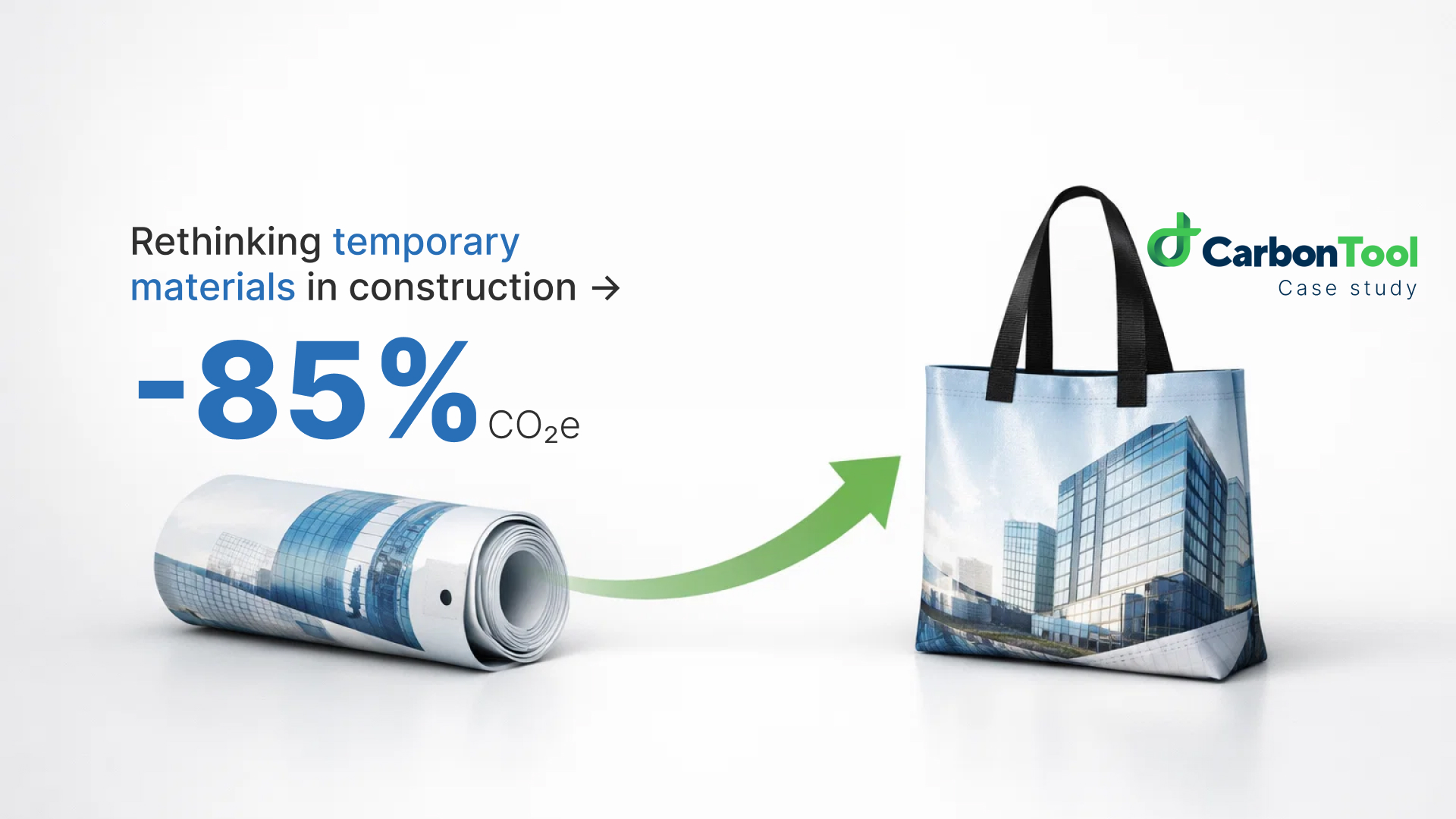
A recent case study developed by CarbonTool, part of the BuildGreen ecosystem, together with Ateliere Fără Frontiere, through its remesh workshop, shows how large the opportunity is when we rethink this temporary category through a circular lens. The comparative analysis found that reusing PVC mesh and banners through upcycling can reduce greenhouse gas emissions by around 6-7 times compared to the conventional production route.
Romania’s broader advertising market has been expanding, and Out-of-Home (OOH) continues to grow. A meaningful share of advertising production is linked to the construction sector, where printed materials are often used briefly and replaced frequently. As construction activity accelerates, the quantity of short-lived printed materials rises, amplifying both climate impact and waste-management challenges.
This is where BuildGreen’s perspective is especially relevant: reducing emissions often depends less on big gestures and more on systematically improving the everyday materials and processes that repeat across projects.
The Result: 85% Lower Emissions
The study compared two scenarios and reported results per 1 square meter of PVC advertising material, using life-cycle assessment principles. The conventional scenario reaches 2.41 kg CO₂e/m², while the upcycled scenario reaches 0.36 kg CO₂e/m². That difference represents an 85% reduction in carbon footprint, achieved through a change in the material model rather than incremental efficiency.
The most powerful insight is where emissions come from in the conventional pathway. Raw materials account for 63% of the total footprint, about 1.53 kg CO₂e/m² out of 2.41 kg CO₂e/m². For procurement, branding and site operations teams, this is a clear signal: the strongest decarbonization lever isn’t usually marginal production tweaks. It’s avoiding virgin material production, especially for items designed to be temporary.
This is exactly what the remesh upcycling model changes. Used advertising materials become the base for new functional products, such as bags, backpacks, wallets, tote bags, accessories and customized promotional items, through a real production process with traceability. Only small quantities of auxiliary materials are added (zippers, thread, fastening elements). And because the material is already printed, the printing stage can effectively be eliminated for the base material, removing a major source of emissions and resource use.
Transport: Higher, but not a deal-breaker
Transport emissions are higher in the upcycling scenario (0.16 kg CO₂e/m² versus 0.09 kg CO₂e/m²) due to collection from multiple locations and additional logistics flows. However, the absolute contribution remains limited and is outweighed by the avoided emissions from virgin material production and printing. Collection can also be optimized by integrating banner pickup with other waste streams, reducing dedicated trips.
One of the most practical outcomes of this case study is that its carbon reduction data can be integrated into ESG reporting, decarbonization strategies and stakeholder communications, starting from everyday purchasing decisions, including promotional items or site materials.
Decarbonization in the built environment is often framed around energy use, embodied carbon, and operational performance. But the broader ecosystem of small material flows on every project also matters. When those flows are measured and redesigned with circularity in mind, the result can be immediate, material and scalable.
This is what BuildGreen aims to support across the region: turning sustainability from intention into implementation, using comparable data, repeatable models and solutions that work in real operations.